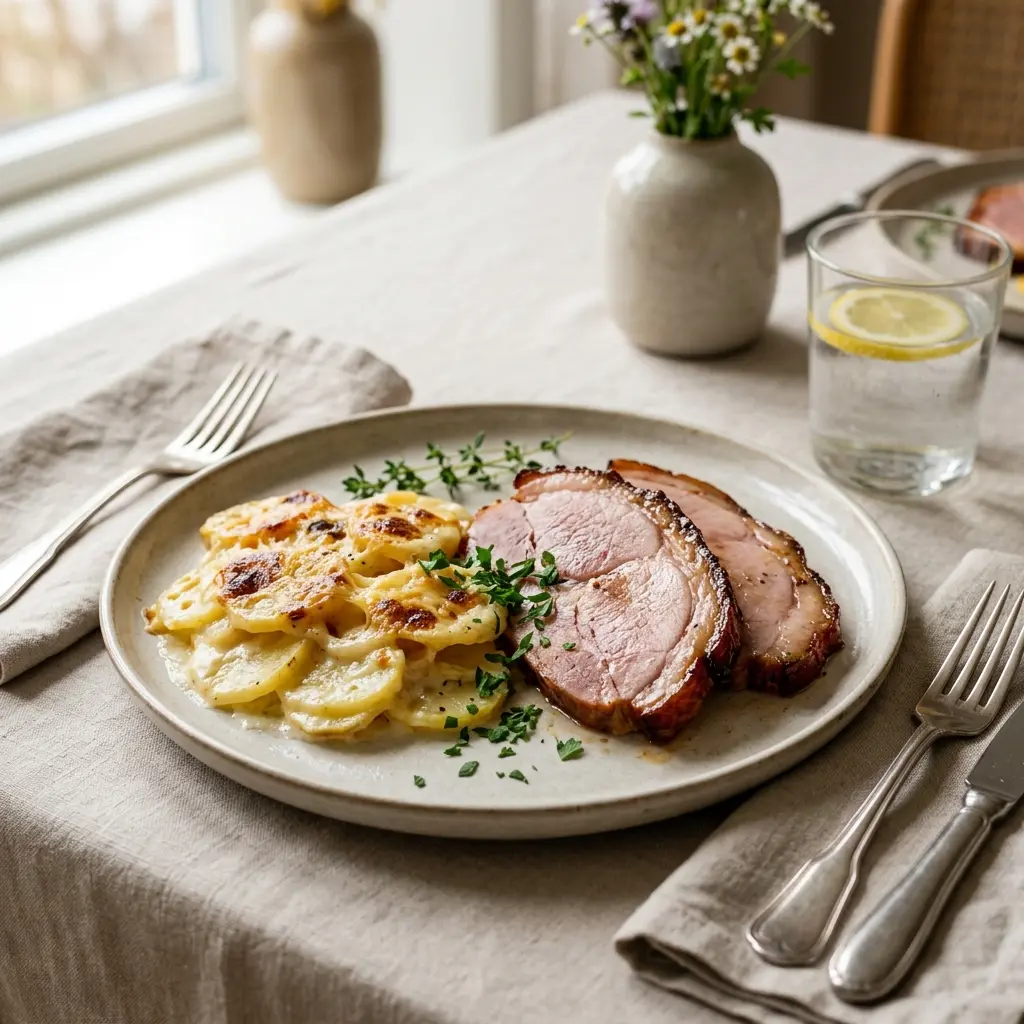
Ham with Dauphinoise Potatoes
Ham with dauphinoise potatoes turns leftover roast ham or a good cooked joint into a rich one-dish dinner for four. Thinly sliced Maris Piper potatoes are simmered briefly in garlic-scented cream and milk, layered with chunks of ham, then baked under a cheddar crust until bubbling and golden. It takes about 1 hour 25 minutes, most of it in the oven, and needs only some greens on the side.
- Total
- 1 h 23 min
- Prep
- 20 min
- Cook
- 53 min
- Serves
- 4
- Per serving
- 690kcal
Buying and preparing ham with dauphinoise potatoes
Use cooked ham that you would happily eat cold: thick-cut slices from the deli counter, or leftover roast ham or gammon. Pick an unsmoked, not-too-salty ham, because baking concentrates the flavour, which is also why the recipe adds only a pinch of salt. Slice the potatoes just before cooking so they do not turn grey. Dauphinoise comes from the Dauphiné region of south-east France and is traditionally made without cheese, so the cheddar crust makes this closer to a gratin.
Making ham with dauphinoise potatoes
Tap a time to start a timer.
- Prepare Heat the oven to 180°C (160°C fan), gas 4. Grease the ovenproof dish with butter. Peel the potatoes and slice them 2–3mm thick, using a mandoline or a sharp knife. Do not rinse the slices, because the starch helps to thicken the sauce.
- Simmer the potatoes Put the cream, milk, garlic, pepper, nutmeg and a pinch of salt into a large saucepan and bring it to a gentle simmer. Add the potato slices and cook gently for , stirring now and then, until they begin to soften but still hold their shape.
- Layer Spoon half of the potatoes and sauce into the dish and spread the ham chunks over the top. Cover with the remaining potatoes, pour over the rest of the sauce and press everything down so the liquid comes almost to the top.
- Bake covered Cover the dish with foil and bake for .
- Add the cheese Remove the foil, scatter over the cheddar and bake for another , until the top is golden and bubbling and a knife slides easily through the middle.
- Rest Leave the dish for before serving, so the sauce thickens enough to cut into neat portions.
Serving and swaps
Steamed green beans, buttered cabbage or a sharp mustard dressing cut through the richness. Gruyère can replace the cheddar for a more traditional taste. If you are cooking a whole joint, a glazed ham gives you the leftovers for this dish, and you can serve the potatoes on their own beside a roast, as in homemade dauphinoise potatoes.
Common problems and fixes for ham with Dauphinoise Potatoes
- The potatoes are still firm in the middle.
- The slices were probably thicker than 3mm, or the dish is deeper than 5cm. Return it to the oven, covered with foil, for another 10 minutes and test again with a knife.
- The sauce looks split or oily.
- The cream was boiled too hard. Keep it at a gentle simmer in step 2, and use double cream rather than single, which splits more easily.
- The top browns before the potatoes are tender.
- Keep the foil on for the full first 25 minutes, and if the cheese is deep golden before the end, lay the foil back on loosely.
- The dish is too salty.
- The ham and cheese already carry plenty of salt, which is why the recipe uses only a pinch. Choose reduced-salt ham if you are sensitive to it.
Frequently asked questions about ham with Dauphinoise Potatoes
Do you have to simmer the potatoes first?
No, but it helps. Simmering in the cream means the slices cook evenly, the sauce starts to thicken and there is no raw centre after baking.
Can I use raw gammon instead of cooked ham?
No. Cook the gammon first, then let it cool and cut it into chunks. Raw gammon will not cook through in time and will release a lot of salty liquid.
How do I store and reheat leftovers?
Cool within 2 hours and keep in the fridge for up to 2 days. Reheat once, covered with foil, at 180°C (160°C fan), gas 4, for 25 minutes, until steaming hot all the way through.
Which potatoes are best for dauphinoise?
Choose a floury variety such as Maris Piper or King Edward. They release starch that thickens the cream, and they soften without falling apart.
How did you like the recipe?
4.8 / 5 · 53 ratings