Seeded Crispbread
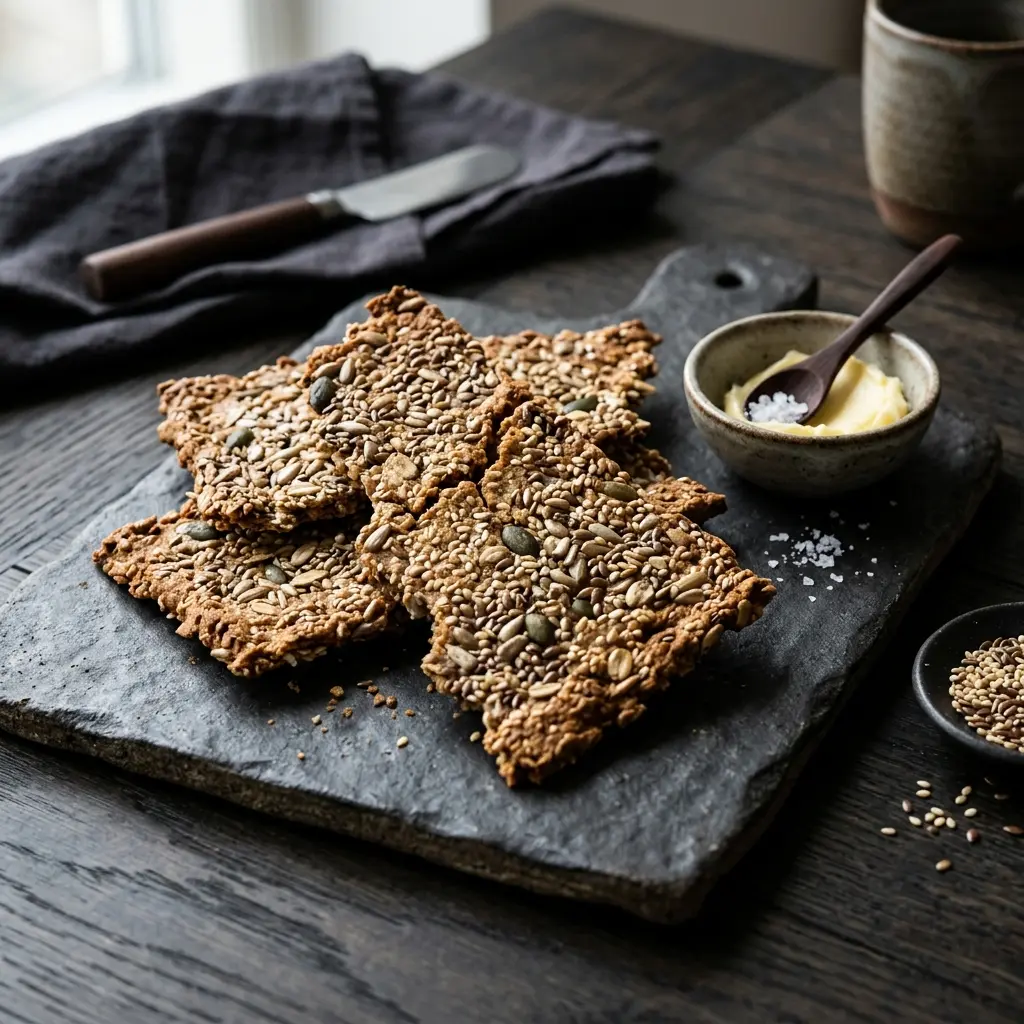
Seeded crispbread needs only rye flour, four kinds of seeds, oil, water and salt, with no yeast and no kneading. The dough is stirred together, rolled very thin between sheets of baking paper and baked slowly until it snaps. This batch fills two baking trays and makes 20 pieces that keep for weeks. It takes about 1¾ hours, with 20 minutes of hands-on work.
- Total
- 1 h 45 min
- Prep
- 20 min
- Cook
- 45 min
- Serves
- 20 pieces
- Per 1 piece
- 140kcal
Before you start: seeded crispbread
The dough is meant to look wet and sticky. The linseeds soak up the water and turn it into a gel as it stands, which holds the seeds together once baked. Do not add extra flour, which makes the crispbread dry and dusty.
Rolling it thin between two sheets of baking paper is the key to the crunch, and it keeps your rolling pin clean. Use the second sheet of paper to check the thickness: you should be able to see the seeds pressing against it.
How to bake seeded crispbread
Tap a time to start a timer.
- Mix the dough Put the sunflower, pumpkin, sesame and linseeds in a large bowl with the rye flour and salt and stir well. Pour in the water and oil and stir to a wet, sticky dough. Leave it for , so the linseeds swell and bind everything together.
- Heat the oven and line the trays Heat the oven to 150°C (130°C fan), gas 2, and line two large baking trays with baking paper.
- Roll it thin Divide the dough in half. Put one half between two sheets of baking paper and roll it out to about 2–3mm thick, roughly 28 x 38cm. Peel off the top sheet and slide the bottom sheet with the dough onto a tray. Repeat with the second half.
- Score the dough Use a pizza cutter or sharp knife to mark each sheet into 10 rectangles (2 columns and 5 rows), cutting through the dough but not the paper.
- Bake Bake for , swapping the trays between the shelves halfway through, until the crispbread is dry, firm and golden at the edges. Watch it for the last , as the seeds darken quickly.
- Cool and break Slide the paper onto a wire rack and leave for . The crispbread crisps up as it cools. Break it into pieces along the lines.
Serving and variations
Break the crispbread into pieces and serve with hummus, or simply eat it on its own as a snack. For a stronger flavour, add 1 tsp of caraway seeds to the dough. For a loaf made with the same seeds, try seeded bread, or the denser seeded rye bread.
Common problems and fixes for Seeded Crispbread
- The crispbread is bendy rather than crisp.
- It was rolled too thick or not baked long enough. Return the pieces to the oven at 120°C (100°C fan), gas ½, for 10–15 minutes, then cool them completely before testing again.
- The dough tears or sticks when rolling.
- Keep it between the sheets of baking paper and dust the paper with a little rye flour. Patch any tears with your fingers before baking, as the dough will not stick back together once it is dry.
- The edges brown before the middle dries.
- Roll the dough to an even thickness, with no thin patches around the border, and swap the trays between the shelves halfway through baking. If a few edge pieces are done early, lift them off and return the rest to the oven.
Frequently asked questions about Seeded Crispbread
How should I store seeded crispbread?
Keep it in a dry airtight container at room temperature for up to 3 weeks. Do not put it in the fridge, as the damp air will soften it.
Can I use different seeds?
Yes, swap in poppy seeds or extra sesame seeds, keeping the total at 300g. Linseeds help bind the dough, so keep at least 50g of them.
Can I use a different flour?
Yes, wholemeal spelt or wholemeal wheat flour work in the same weight, with a milder flavour than rye. The crispbread will be a little lighter in colour.
How thin should I roll it?
About 2–3mm, roughly the thickness of two coins. Thinner crispbread is crunchier, but anything under 2mm can burn at the edges.
How did you like the recipe?
4.9 / 5 · 28 ratings