French Baguettes
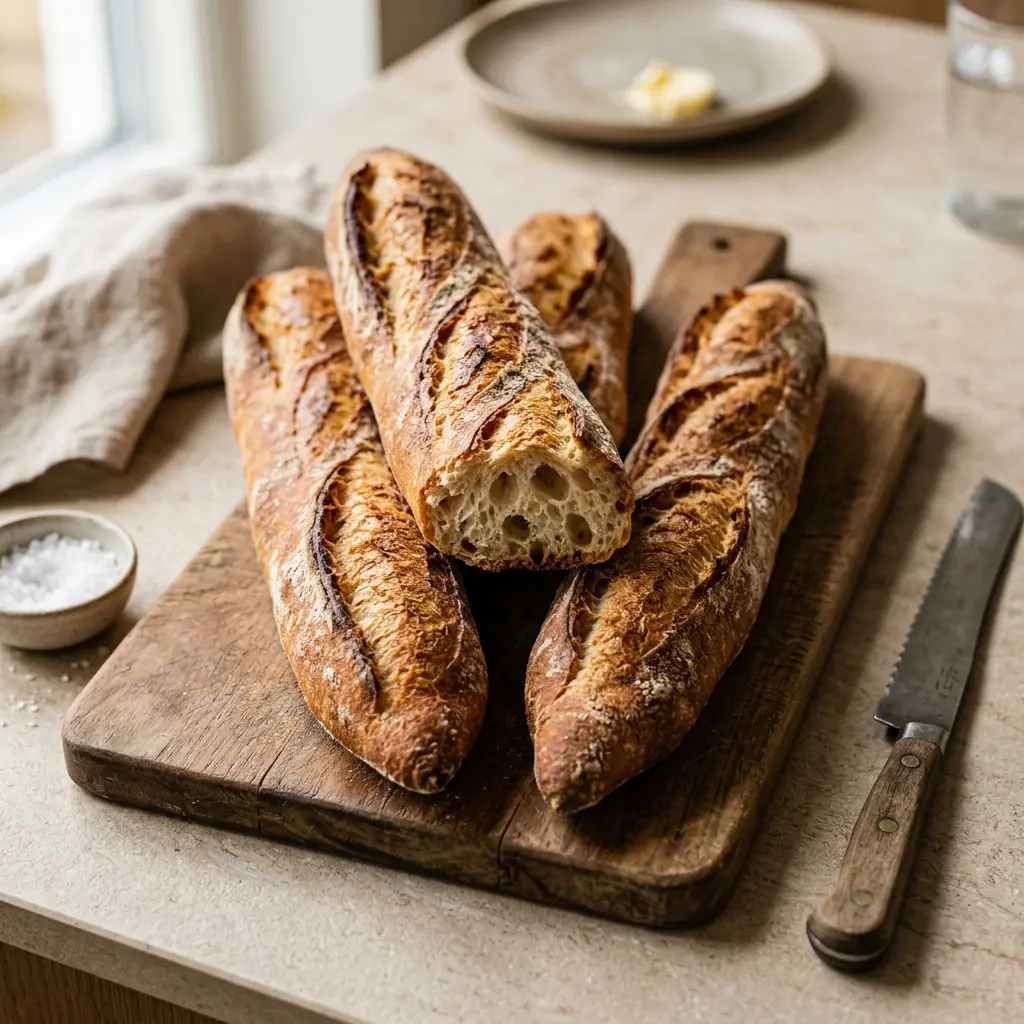
French baguettes need only flour, water, yeast and salt, but they depend on a wet dough, a long rise and plenty of steam in a hot oven. This recipe makes four slim loaves of about 215g each, with a thin, crackling crust and a soft, airy middle. Most of the 3.5 hours is spent waiting for the dough to rise, so the work is easy to fit around other jobs.
- Total
- 3 h 25 min
- Prep
- 25 min
- Cook
- 25 min
- Makes
- 4 baguettesabout 215g each
- Per 1 baguette
- 420kcal
Getting the dough for french baguettes right
A baguette dough is wetter than a standard loaf: 350ml water to 500g flour is a hydration of 70 per cent. That stickiness is what gives the large, irregular holes inside. Strong white bread flour holds the gas well, so plain flour will give you a flatter, denser loaf.
The salt measures 2 per cent of the flour by weight, which is why it is worth weighing it. Keep it apart from the yeast at first, as direct contact slows the yeast down. Knead for the full 10 minutes, and the dough is ready when a small piece can be stretched thin enough to see light through it without tearing.
The method for french baguettes
Tap a time to start a timer.
- Mix and knead Put the flour in a large bowl with the salt on one side and the yeast on the other. Add the lukewarm water and mix with your hand for into a rough, sticky dough. Knead on a lightly floured surface for , using a scraper if it sticks, until smooth and stretchy.
- First rise Return the dough to the bowl, cover with a damp tea towel and leave in a warm place for , until doubled in size.
- Shape Tip the dough onto a floured surface and cut it into 4 equal pieces. Flatten each into a rectangle, fold the long edges into the middle and press the seam shut. Roll under your palms to about 30cm long. Place two baguettes, seam-side down, on each lined tray.
- Second rise and score Cover with tea towels and leave for until puffy. Twenty minutes before the end, heat the oven to 220°C (200°C fan), gas 7, with an empty roasting tin on the bottom shelf. Slash each loaf with 3 or 4 quick diagonal cuts about 1cm deep.
- Bake Put the trays on the middle and top shelves. Carefully pour the boiling water into the hot roasting tin and shut the door at once. Bake for , swapping the trays halfway, until deep golden and hollow-sounding when tapped underneath. Cool on a wire rack for at least .
Serving and keeping your baguettes
Baguettes are at their best within a few hours of baking. Serve them warm with butter, alongside soup, or sliced for sandwiches such as a grilled tuna sandwich. They also make good crostini or a base for Italian bread salad.
Leftover loaves keep in a paper bag or wrapped in a clean tea towel until the next day. For longer storage, freeze them whole for up to 1 month, then refresh in a 200°C (180°C fan), gas 6, oven for 5–8 minutes before serving.
Common problems and fixes for French Baguettes
- The dough is too sticky to handle.
- It is meant to be wet, as that creates the open crumb. Use a scraper and lightly floured hands rather than adding lots of flour, and it becomes smooth after 10 minutes of kneading.
- The crust is pale and soft.
- The oven was not hot enough or there was too little steam. Preheat for the full 20 minutes with the tin inside, add the boiling water as the loaves go in, and bake until deep golden.
- The loaves spread flat instead of rising.
- The dough is over-proved or the shaping is loose. Stick to 45 minutes for the second rise, and roll the dough firmly so the surface is tight before scoring.
Frequently asked questions about French Baguettes
Why did my baguettes not rise?
The yeast is the most likely cause: water above about 45°C weakens it, and it dies at around 55°C, so use lukewarm water and check the date on the sachet. A cold, draughty kitchen also slows the rise, so leave the dough in the warmest room.
Can you make the dough the night before?
Yes. After kneading, cover the bowl and chill it for 8–12 hours instead of the 90-minute rise. Bring it out for 30 minutes, then shape, prove and bake as usual.
Can you bake them without a baguette tray?
Yes. Two flat baking trays lined with baking paper work well, as long as the loaves are spaced apart. A floured tea towel pleated between the loaves keeps them from spreading.
Why is my crust too hard rather than crisp?
The baguettes have been baked too long or cooled in a draught. Take them out at deep golden, not dark brown, and leave them on a rack rather than wrapping them while warm.
How did you like the recipe?
4.9 / 5 · 16 ratings