Homemade Cinnamon Rolls
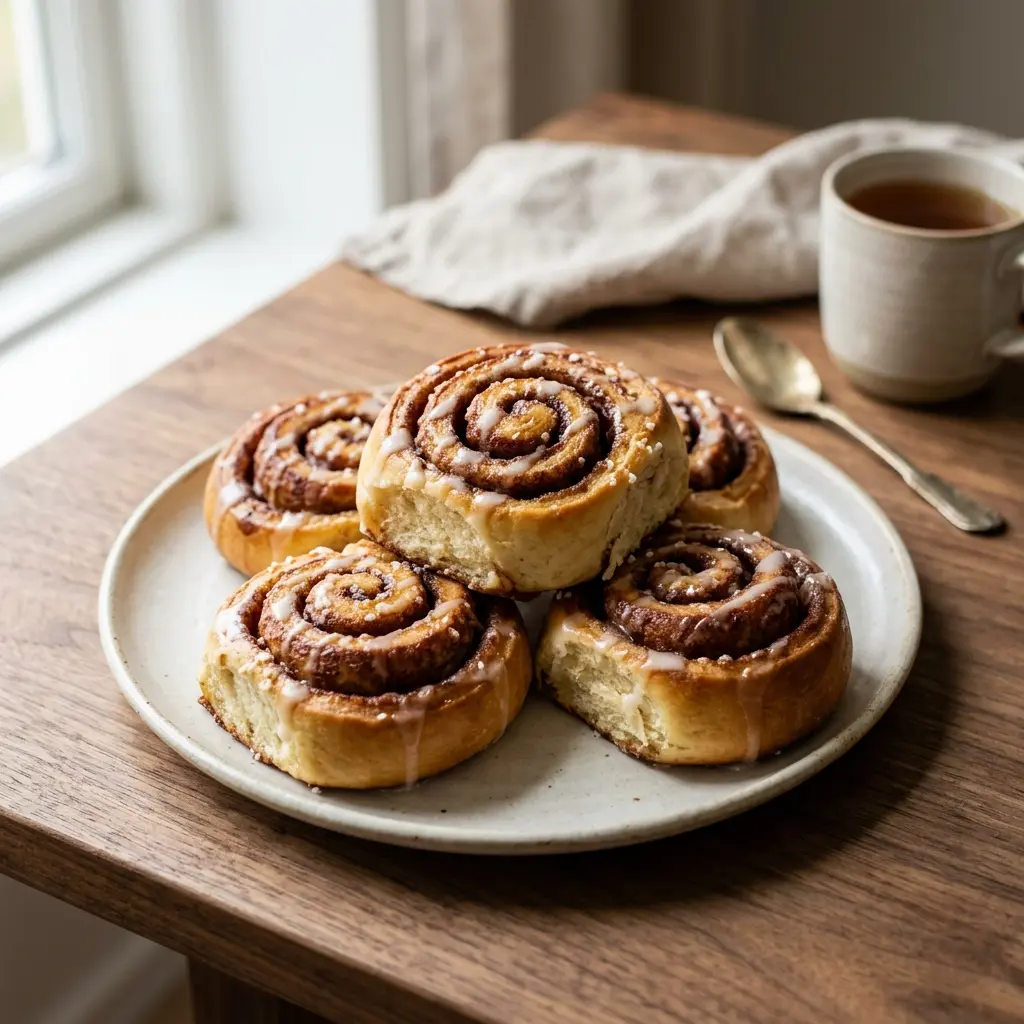
Homemade cinnamon rolls need patience more than skill: a soft yeasted dough, a buttery cinnamon-sugar filling and about 2 hours 45 minutes, most of it hands-off rising time. The result is twelve pillowy, sticky rolls with a simple icing, ideal for a weekend breakfast or a bake to share with a cup of coffee. Swedish kanelbullar are their best-known relative.
- Total
- 2 h 45 min
- Prep
- 40 min
- Cook
- 25 min
- Serves
- 12 rolls
- Per 1 roll
- 345kcal
Making homemade cinnamon rolls ahead
You can do the work the evening before. After cutting and arranging the rolls in the tin, cover tightly and chill overnight for up to 12 hours. In the morning, leave the tin at room temperature for 45–60 minutes until the rolls are puffy, then bake as normal. The slow rise also deepens the flavour.
Baked rolls keep in an airtight container for up to 2 days. To freeze, wrap them un-iced and freeze for up to 3 months. Defrost at room temperature, warm for 5–8 minutes in a 160°C (140°C fan), gas 3 oven, then ice.
Preparing homemade cinnamon rolls
Tap a time to start a timer.
- Mix the dough In a large bowl, combine the flour, caster sugar and yeast, and put the salt on the other side of the bowl so it does not touch the yeast. Add the lukewarm milk, melted butter and egg and stir until you have a shaggy dough.
- Knead and prove Knead on a lightly floured surface for , or for with a dough hook, until smooth and stretchy. Put the dough in an oiled bowl, cover and leave somewhere warm for 1 hour, until doubled in size.
- Roll and fill Mix the brown sugar and cinnamon. Roll the dough out to a 30 x 40cm rectangle, about 5mm thick. Spread with the soft butter, leaving a 1cm strip clear along one long edge, then scatter over the cinnamon sugar. Roll up tightly from the opposite long edge and press the clear strip down to seal.
- Cut and second rise Trim the ends, then cut into 12 slices about 3cm thick, using dental floss or a serrated knife. Lay the slices cut side up in the lined tin in 3 rows of 4. Cover and leave for , until puffy and touching each other.
- Bake Heat the oven to 180°C (160°C fan), gas 4, about before the end of the second rise. Bake the rolls for , until deep golden brown and cooked through in the centre. If they colour too fast, cover loosely with foil.
- Ice Leave the rolls to cool in the tin for . Stir the icing sugar and water into a thick, smooth icing and drizzle over the warm rolls. Serve while still soft.
Icing, flavours and swaps
The simple icing here suits most tastes, but you can swap it for a cream cheese frosting like the one on this carrot cake with cream cheese frosting. A pinch of ground cardamom in the filling gives a Scandinavian flavour, and the grated zest of an orange adds freshness.
For a smaller batch cooked in the air fryer, see the air fryer cinnamon rolls.
Common problems and fixes for Homemade Cinnamon Rolls
- The dough has not risen after an hour.
- The milk was probably too hot or too cold, or the yeast was out of date. Milk should feel comfortably warm, as milk that feels hot can weaken the yeast. Give the dough extra time somewhere warmer, up to 30 minutes more.
- The rolls are dry and heavy.
- Too much flour or too long in the oven. Weigh the flour, keep the dough slightly tacky and take the rolls out as soon as they are deep golden.
- The filling leaks out and the swirl looks messy.
- Melted butter runs, so use very soft butter instead. Roll the log as tightly as you can and cut with floss, which slices cleanly instead of squashing the layers.
- The icing runs off and disappears.
- The rolls were too hot. Leave them for 10 minutes first, and add the water a little at a time so the icing is thick enough to hold its shape.
Frequently asked questions about Homemade Cinnamon Rolls
Can I use plain flour instead of bread flour?
Yes, in the same weight. The rolls will be a little less chewy and may rise slightly less, but they still taste good.
Can I use ordinary dried yeast?
Yes. Stir 7g active dried yeast and a pinch of the sugar into the warm milk and leave it for 10 minutes until frothy, then add it to the flour with the other wet ingredients.
How can I tell when the dough has proved?
It has doubled in size and a floured fingertip pressed into it leaves a dent that springs back slowly. If it springs back at once, give it longer.
How do I know the rolls are baked through?
They are deep golden on top and sound hollow when you tap the base of a roll at the edge. The centre roll should feel springy, with no raw dough in the spiral.
How did you like the recipe?
4.7 / 5 · 64 ratings